
By Digital Education Council
.
April 10, 2026
The Digital Education Council's AI in Higher Education Latin America (LATAM) Survey 2026 gathered responses from 7,319 faculty members across 29 higher education institutions in the region.
What emerges from the data is that AI adoption is widespread and sentiment is positive, but usage remains measured and selective.
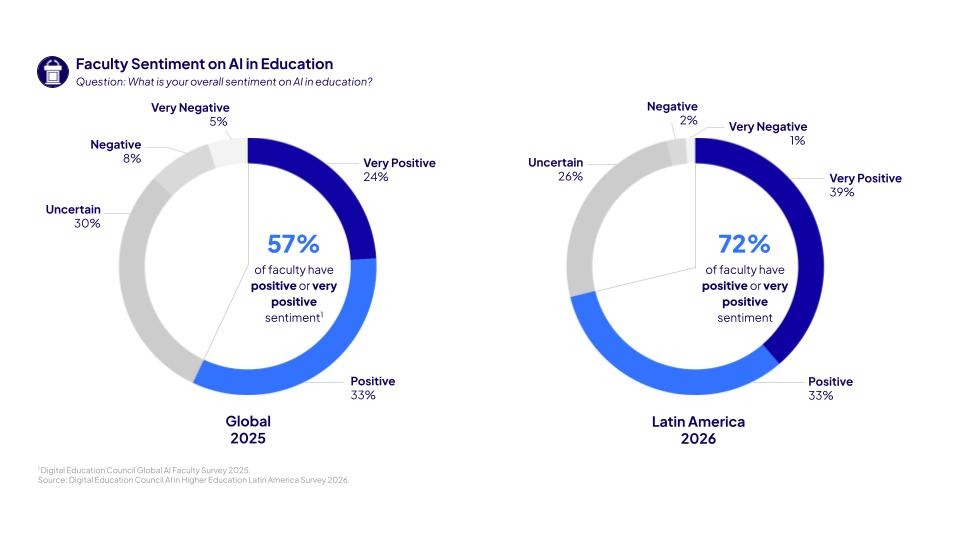
72% of faculty in the region report “positive” or “very positive” views on AI in education, compared to 57% globally (DEC Global AI Faculty Survey 2025). This suggests stronger regional openness to AI, even as questions around its role in teaching and assessment persist.
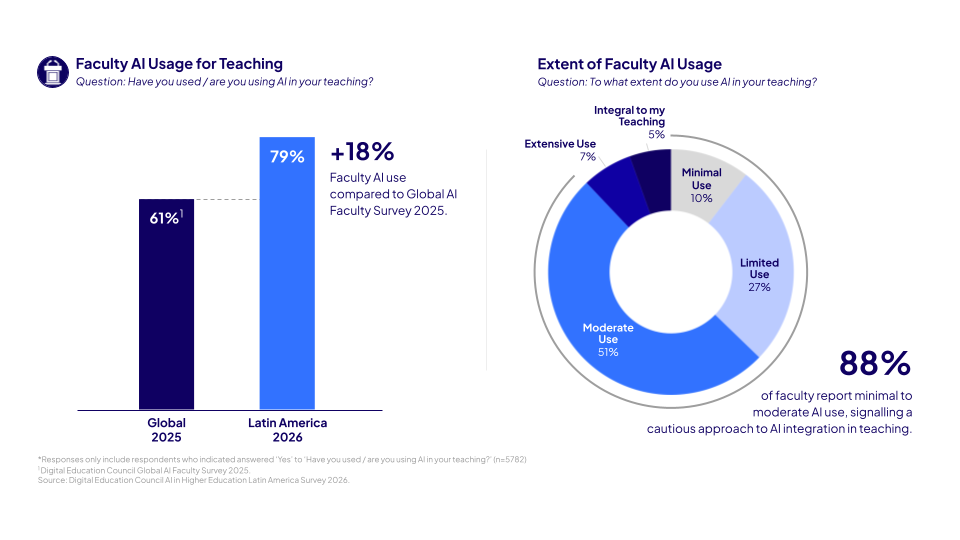
79% of faculty in LATAM report using AI in their teaching, an 18% increase from the global figure recorded in 2025.
However, this adoption is not yet translating into deep pedagogical integration. 88% of faculty report “minimal” to “moderate” engagement with AI, indicating that usage remains largely at the surface level.
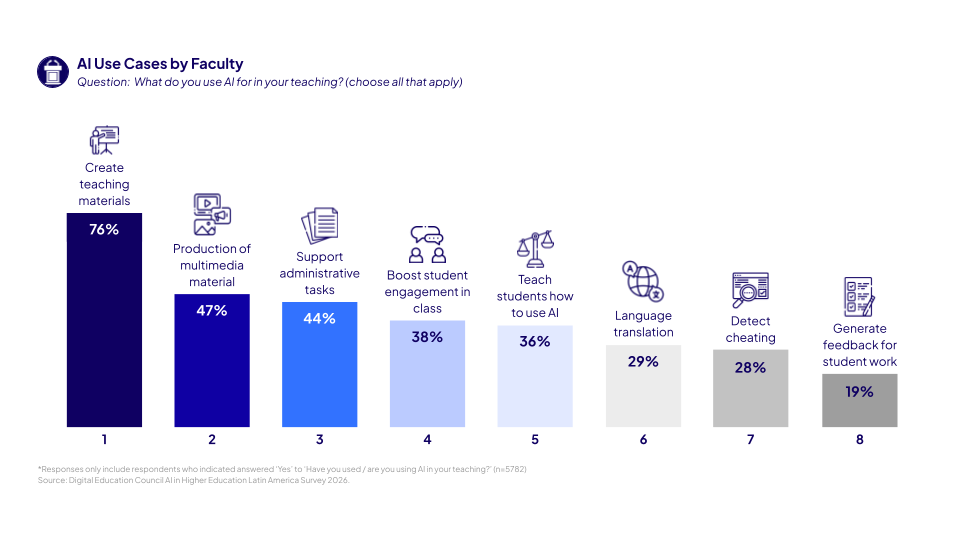
The survey indicates faculty primarily use AI to create teaching materials, produce multimedia content, and support administrative tasks.
The lowest adoption rates are seen in assessment-related use cases such as detecting cheating and generating feedback. This suggests these applications are among the least well received, reflecting a continued preference for more authentic, trustworthy, and human-led approaches to assessment and feedback.
In practice, AI adoption remains concentrated in supporting existing workflows, with more complex and pedagogically sensitive applications seeing lower uptake.
As AI becomes embedded in teaching, the focus is shifting to managing its implications.
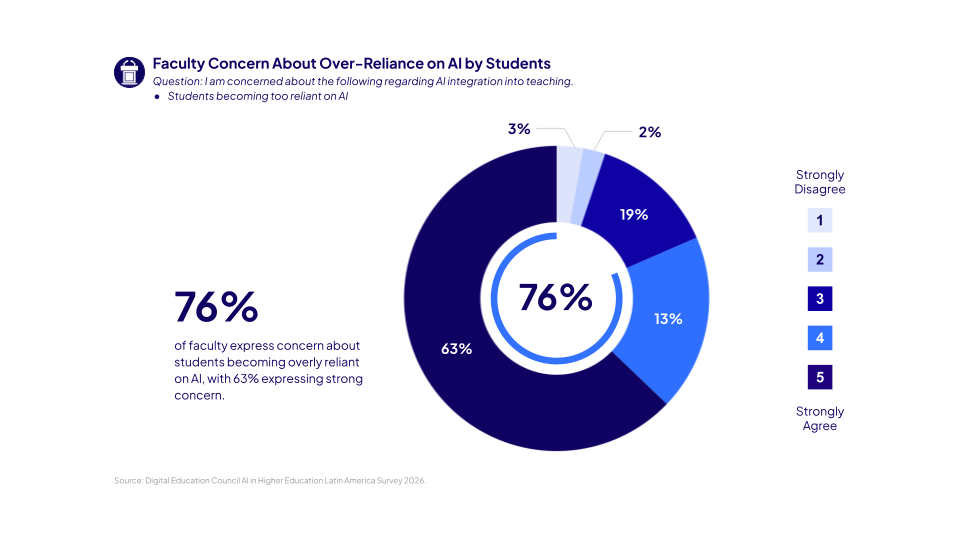
76% of faculty express concern about students becoming too reliant on AI, with 63% expressing strong concern.
When asked about AI integration into teaching, 70% of faculty report being concerned about the bias and accuracy of AI-generated content and information.
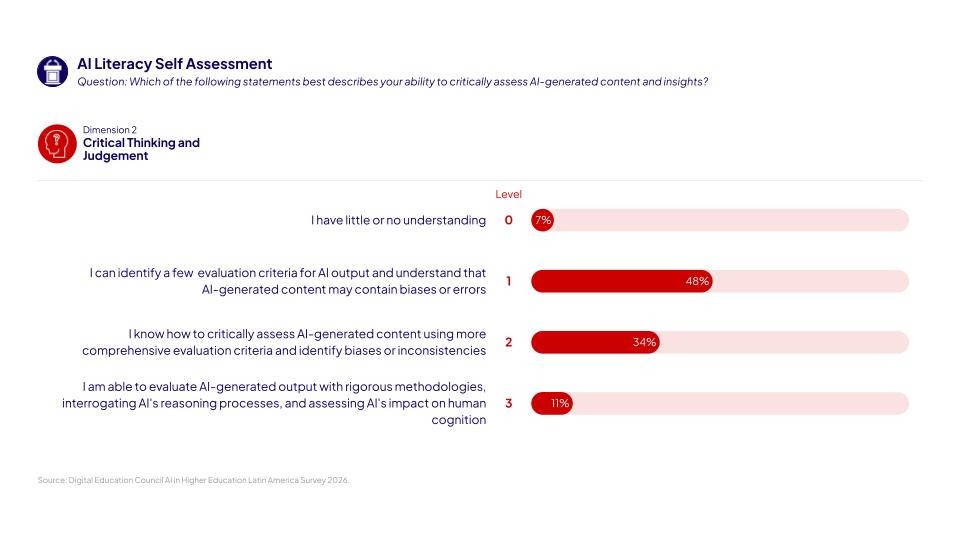
These concerns are reinforced by faculty’s feeling that their ability to critically evaluate AI output is limited, with many expressing that they have only a basic understanding of how and where AI may fall short.
Almost half of faculty (48%) say they can recognise issues within AI-generated output such as biases or errors. Only 11% report the ability to critically evaluate AI output with rigorous methodologies and reasoning processes.
A majority (55%) of faculty indicate that they lack strong critical judgement when assessing AI-generated content.
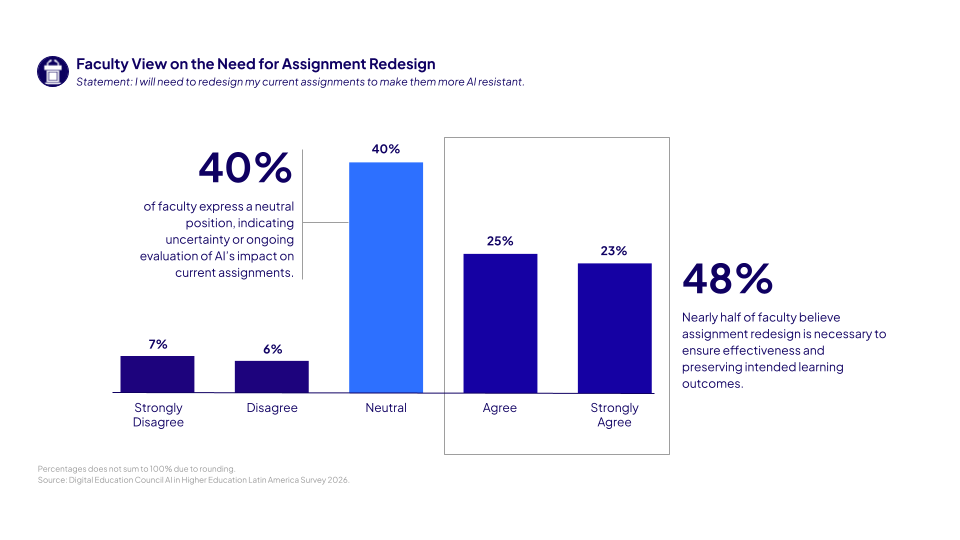
Traditional approaches to teaching and learning are being challenged by the realities of AI use, driving the need to rethink both assignment design and broader student evaluation methods.
48% of faculty believe assignment redesign is necessary to preserve intended learning outcomes, while a further 40% remain neutral. This points to widespread uncertainty rather than resistance around AI’s impact on existing assignment models.
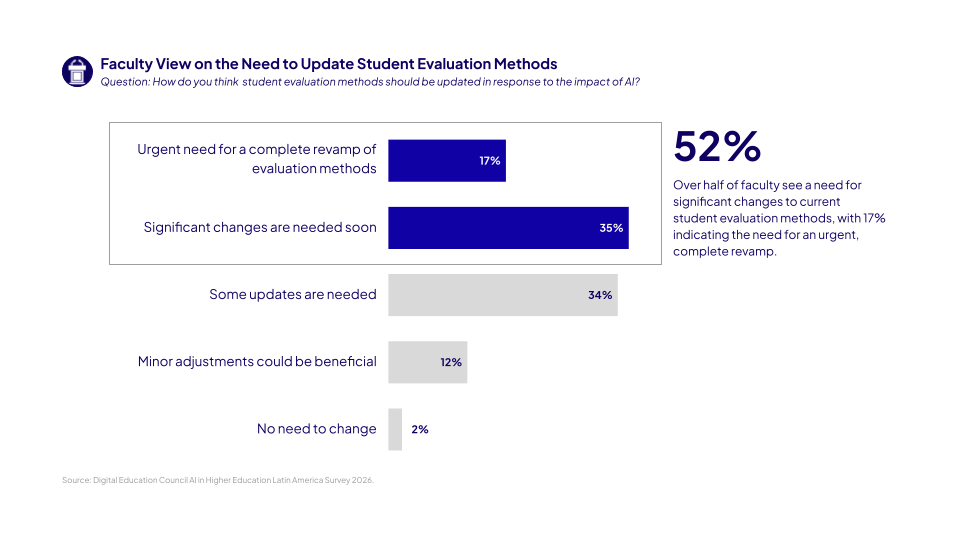
Similarly, 52% of faculty see a need for significant changes to student evaluation methods in response to the impact of AI, with 17% calling for a complete overhaul.
Faculty recognise the limitations of current assessment and evaluation models, but there is no clear consensus on what should replace them.
Across the data, it is evident that AI is becoming embedded in everyday teaching practice across LATAM. Overall, the survey indicates that faculty in LATAM show higher levels of openness and use of AI than the global average, yet their engagement remains cautious and selective.
The Digital Education Council AI in Higher Education Latin America Survey 2026 is available in English and Spanish for public download here.
For additional insights, DEC Members can access the Full Briefing and Report via the Member Area.
Further Reading: The Next Era of Assessment: A Global Review of AI in Assessment Design