
By Digital Education Council
.
February 23, 2026
In discussions about artificial intelligence adoption in higher education, a common assumption persists: that senior faculty are more resistant to AI-driven change.
This belief typically stems from the perception that faculty with longer teaching careers are more sceptical of AI or are less willing to experiment with new technologies.
However, data from the DEC AI in Higher Education Latin America Survey 2026 challenges this narrative.
Across all teaching experience levels, faculty AI usage shows no significant variation by years of experience. Between 75% and 82% of faculty report already using, or having used, AI in their teaching.

Senior faculty, defined as those with over two decades of teaching experience, report AI usage rates only marginally lower than those of less experienced peers, with a difference of approximately only 7 percentage points.
Looking ahead, expectations of future AI use are even more uniform.
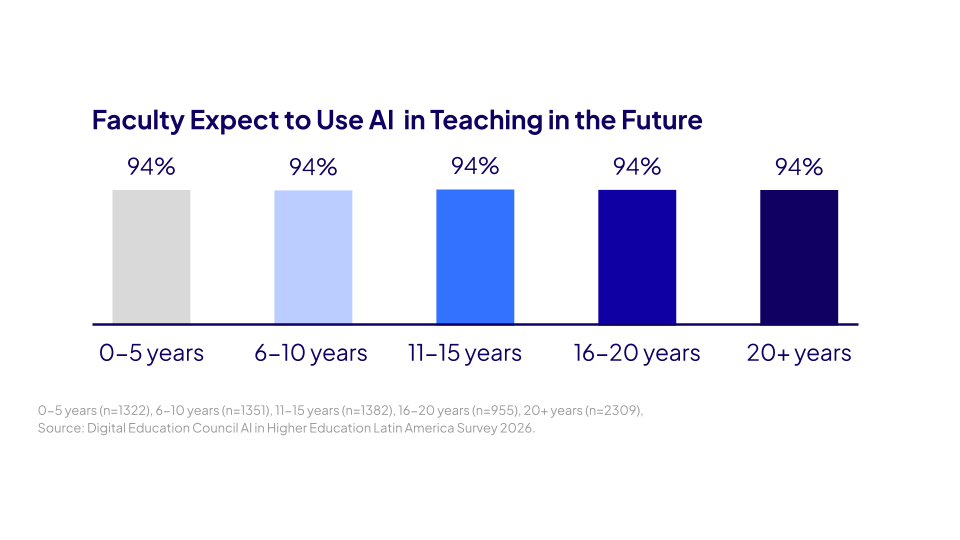
Approximately 94% of faculty across all experience brackets expect to use AI in their teaching going forward. This level of alignment suggests that AI is no longer viewed as an experimental or optional tool, but as a mainstream component of academic practice, independent of seniority.
Perceptions of AI’s role in higher education further reinforce this point. Around 69% to 71% of faculty across experience levels view AI in education as an opportunity rather than a challenge. Once again, senior faculty align closely with early- and mid-career colleagues.
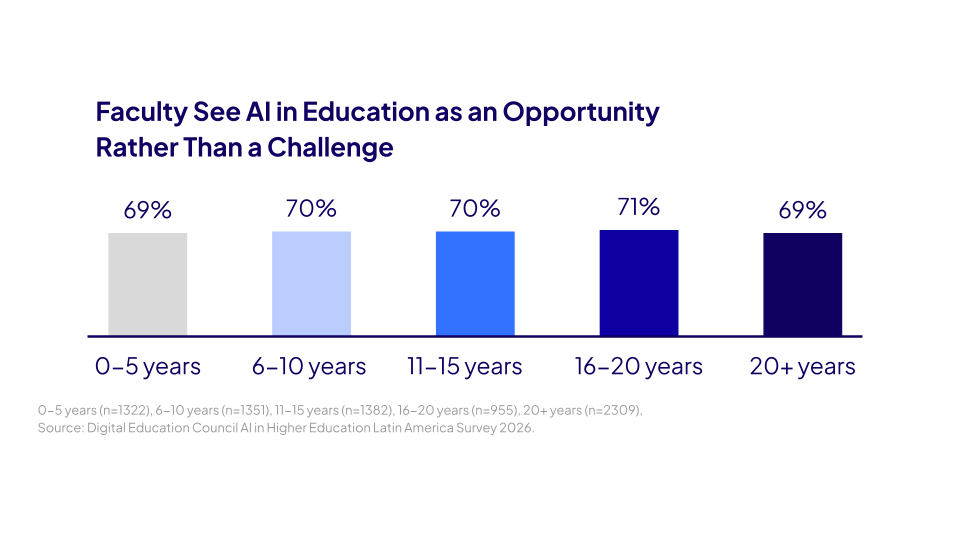
Overall, attitudes toward AI’s potential, benefits, and risks show little variation across years of teaching experience.
Taken together, these findings challenge the narrative that resistance to AI is primarily generational or rooted in seniority.
Instead, the data points to structural and support-related factors — rather than experience or seniority — as the primary barriers to AI adoption.
Rather than focusing on “who” needs persuading to use AI, institutions should turn their attention to the policies, frameworks and AI literacy upskilling required to support meaningful and scalable AI adoption.
The full AI in Higher Education Latin America Survey 2026 is available for public download here.
Digital Education Council members can access the complete report and additional insights via the Member Area.