
By Digital Education Council
.
March 6, 2026
“There are going to be winners and losers, not only across countries but also within countries. The better-educated are likely to be less negatively affected or to see larger gains because they are better prepared to take advantage of opportunities, such as technologies.” — Michal Rutkowski, Regional Director for Human Development, World Bank. (Interview with DEC President, Daniel A. Bielik, April 2025)
According to the Digital Education Council’s AI in the Workplace 2025 report, 72% of employers believe that AI adoption will reduce the headcount required in the workforce.
The top three roles perceived to be most vulnerable include marketing, data-focused and finance functions, driven by the rapid proliferation of automation tools in these areas.
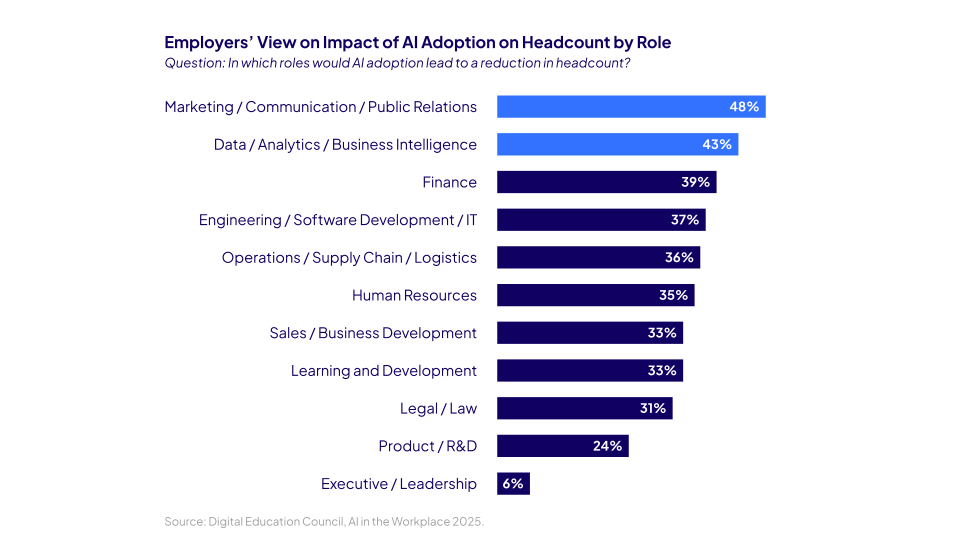
This projected shift indicates a pressing need for proactive workforce planning and re-skilling, especially for roles identified as most at-risk of displacement.
Findings from the report indicate that although AI will reduce headcount in certain functions, it will create new jobs.
62% of employers anticipate new roles driven by AI, reflecting confidence in job creation within their sectors.
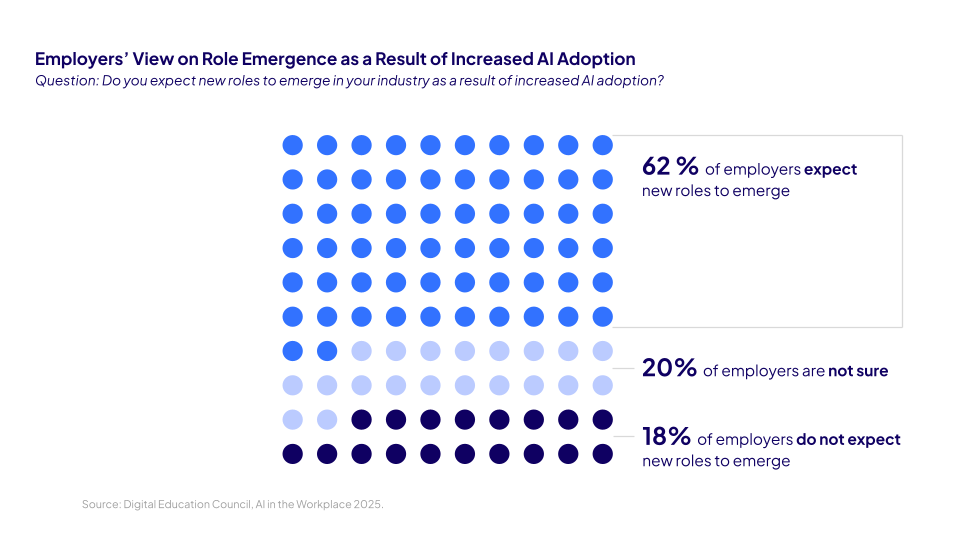
However, the picture is not entirely optimistic. 18% percent of employers do not expect new roles to emerge, and a further 20% remain unsure. This highlights a degree of uncertainty about how AI will reshape roles within their sector.
The impact of AI adoption is likely to be twofold: while new roles will emerge, individuals who do not adapt may face a contraction of opportunities. This divergence will not depend solely on technology but also on the ability of institutions and individuals to anticipate and respond to change.
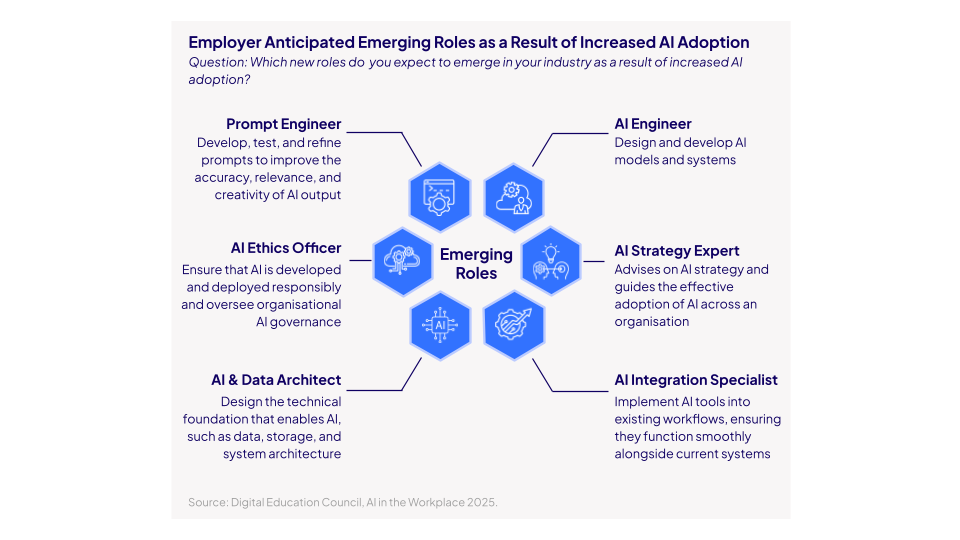
Across industries, employers anticipate the rise of new job roles that are directly linked to the technical development and deployment of AI, such as prompt engineers, AI engineers, and AI strategy experts. These anticipated roles remain largely homogeneous and AI-centric, with limited differentiation across industries.
This suggests that we are merely seeing the first wave of emerging AI roles, focused primarily on implementing and managing AI systems rather than reimagining how AI will reshape core, sector-specific functions.
While these roles reflect the current wave of AI adoption, they do not yet capture the deeper, more nuanced ways AI may reshape jobs within specific sectors.
The continued advancement of AI capabilities and deeper organisational integration will likely give rise to a second wave of more industry-specific roles, reflecting the workflows and opportunities unique to each sector.
Nearly all employers (98%) expect AI use to increase within their teams and organisations as they look to capture the broad opportunities AI presents, specifically in boosting efficiency and productivity, and automating workflows.
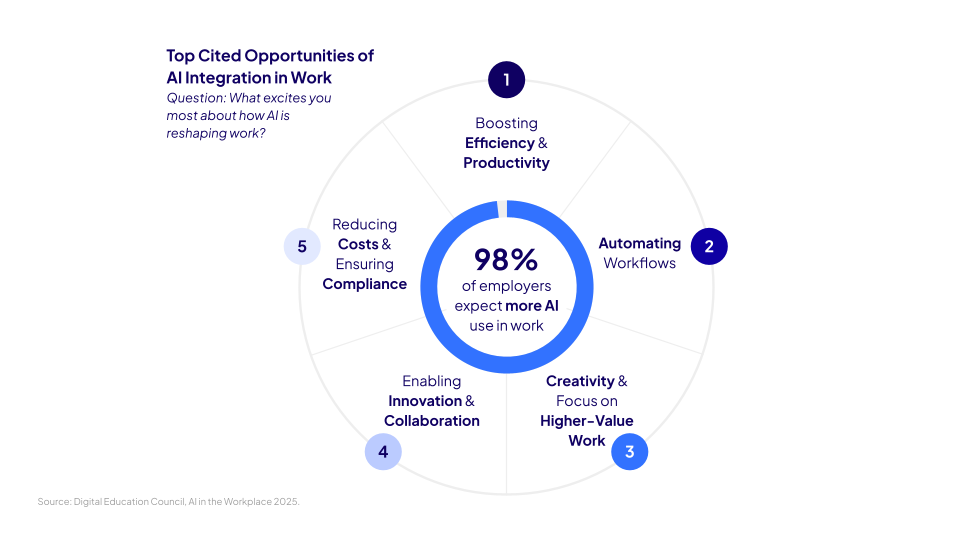
With organisations moving towards more sophisticated AI systems, such as Agentic AI, new automation use cases are expected to emerge, streamlining work processes even further.
Ultimately, the future of work will depend less on the technology itself and more on how effectively individuals and institutions prepare people to work alongside it.
Digital Education Council’s AI in the Workplace 2025 Report is available for public download here.
DEC members can access the complete report and additional insights via the Member Area.