
By Digital Education Council
.
May 22, 2026
Why does productivity drop when you implement AI?
Organisations and institutions introducing AI follow a consistent pattern. Early efficiency gains are followed by a period of disruption as workflows change faster than the capabilities people have to operate within them.
The Digital Education Council's AI Skills Opportunity Map, a Google.org engaged global AI readiness research initiative, identifies this as the productivity paradox of AI adoption.
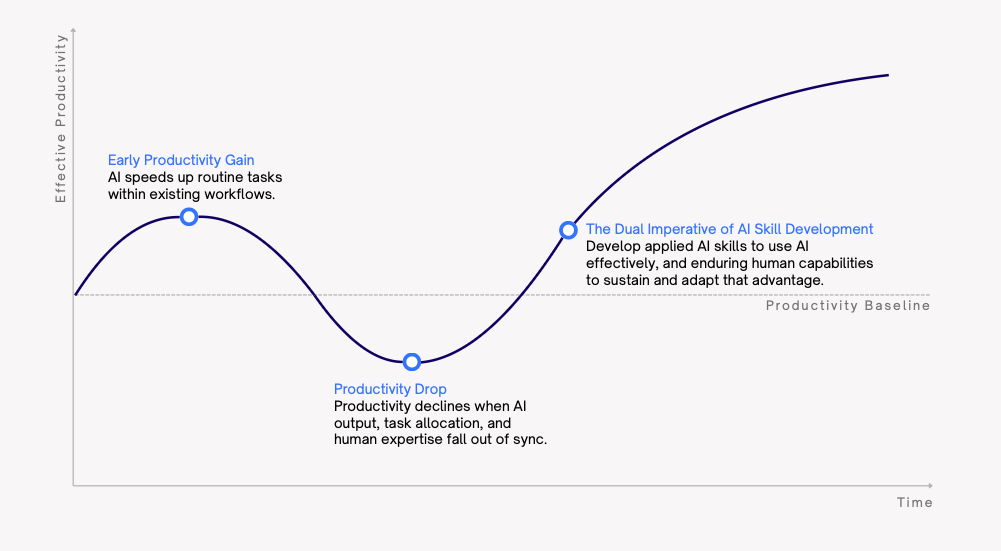
The early gain is real but constrained.
Routine tasks such as drafting and synthesising information can be delegated to AI systems, enabling faster execution within existing workflows. At this stage, AI speeds up what people already do but it does not transform how work is structured or how decisions are made.
The drop that follows is not a failure of the technology in itself. As the report identifies, it stems from a set of mismatches between what AI enables and what people are currently equipped to handle.
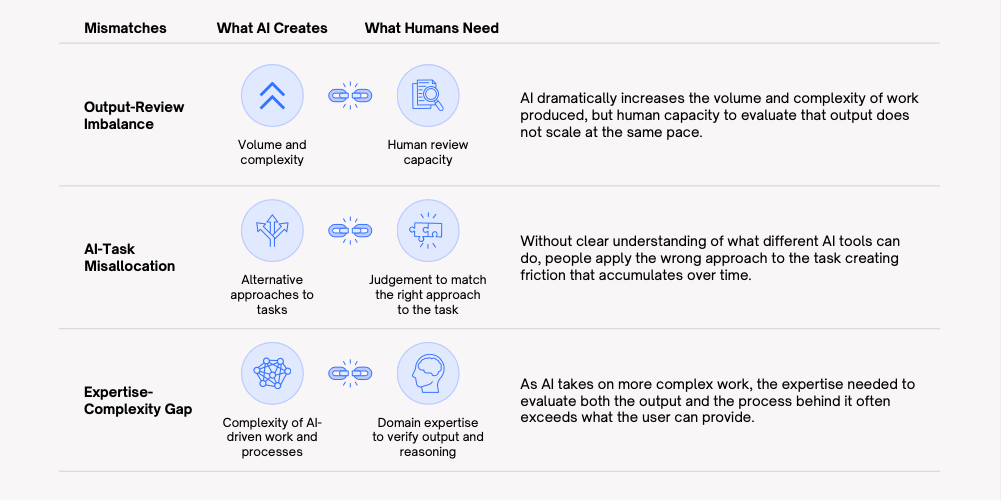
The first is an output-review imbalance. AI makes it easy to produce more in far less time, rapidly increasing the volume of material while human capacity to review it does not scale at the same pace. Where prompting skills are underdeveloped, vague prompts produce poor outputs, triggering repeated cycles of re-prompting and revision.
As review volume accumulates, evaluation quality declines: people skim rather than read AI-generated material carefully, and errors slip through the cracks.
The second is task misallocation. The reality is that not every task benefits from AI. Without a clear understanding of what different tools can do, people may apply AI in ways that do not match the nature of the task.
Manual work may actually be faster, or overly complex AI systems may be chosen when simpler methods would be more reliable. Over time, these small inefficiencies accumulate, creating friction in everyday work.
Finally, an expertise-complexity gap explains why a productivity drop is more common than expected. As AI moves into analysis and domain-specific reasoning, the person evaluating the output needs sufficient expertise to know when it is sound and when it is not.
Where that expertise is thin, AI-generated work passes through without adequate scrutiny – not because the person is careless, but because they lack the basis to challenge it. This creates a silent erosion of quality. Work is produced quickly and appears complete, but the underlying judgement is shallow.
Resolving these mismatches requires two distinct layers of skill development.
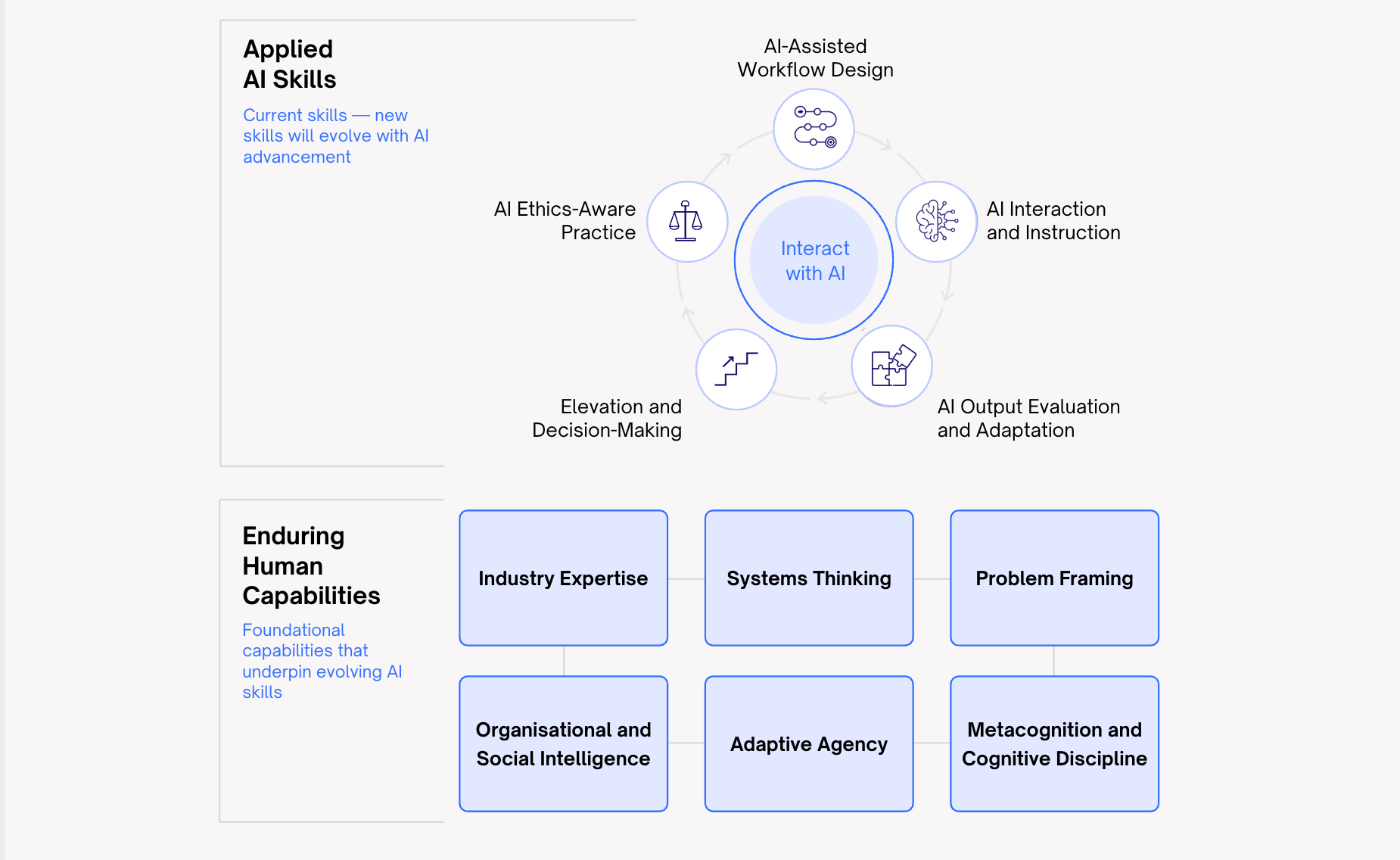
The first looks at applied AI skills: the practical capabilities that govern how effectively someone works with AI day to day.
These include designing tasks with the right human-AI division of labour, instructing AI with precision, evaluating and adapting AI output, building on that output to elevate its value for decisions, and applying ethical judgement throughout. As such, these skills directly address the mechanics of the productivity drop.
The second layer covers what the report terms enduring human capabilities: the domain expertise, systems thinking, problem framing, and organisational intelligence that sustain productive AI use over time.
These are the capabilities AI consistently lacks the contextual basis to replicate, such as the judgement to assess output in context and the self-awareness to resist over-reliance on AI.
Unlike applied AI skills, which will evolve as the tools do, these capabilities remain relevant regardless of how the technology changes.
When individuals develop the right combination of applied AI skills and deeper human capabilities, they move beyond the initial disruption of AI adoption and begin to unlock new forms of value creation.
The Digital Education Council AI Skills Opportunity Map is available for download here.