Key Insights


01/
07
·
Key Challenges

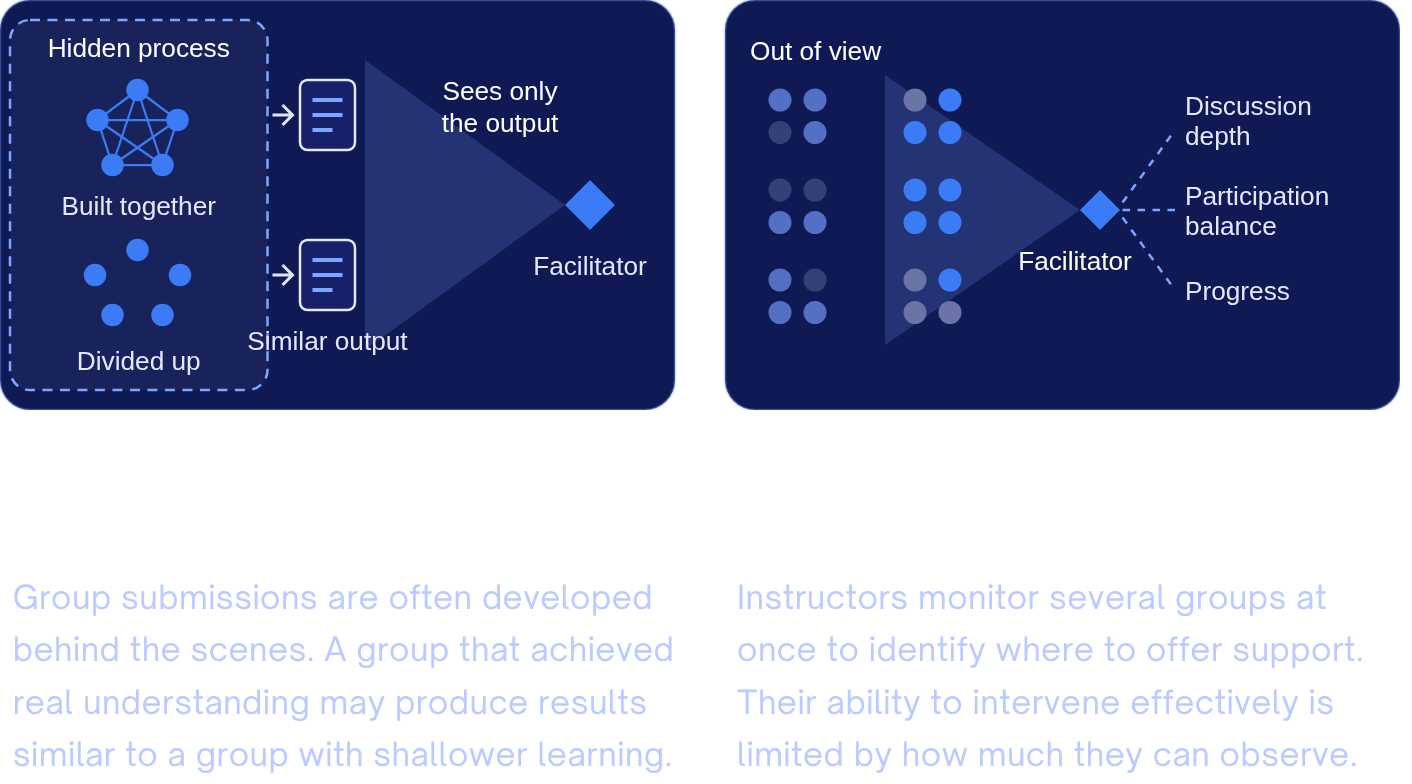
Collaborative Learning Is Already Hard to Manage

Group learning depends on how students interact, and most of that happens out of the instructor’s view. Instructors are able to see the finished work but not the process in which the group produced it, and they cannot watch every group at once.

02/
07
·
Key Challenges

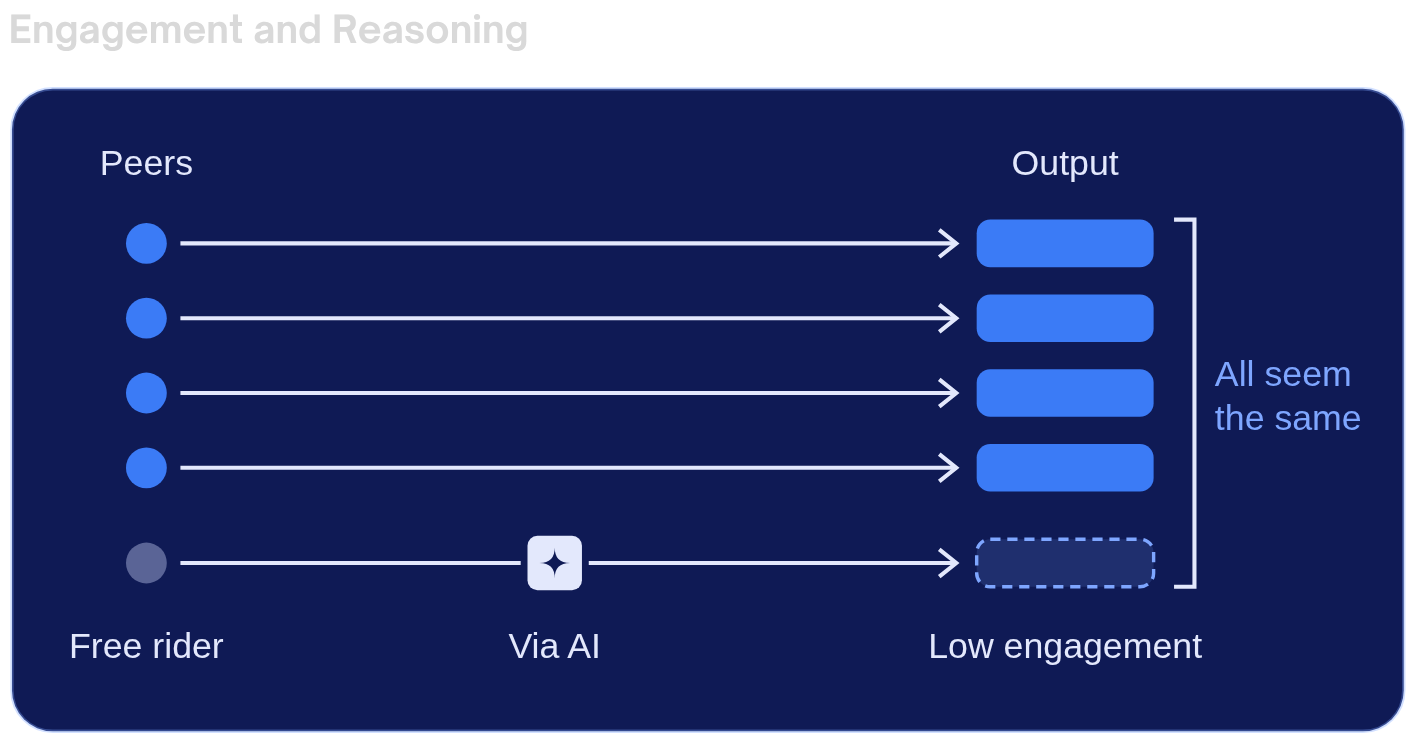
Contributions no longer signal engagement

Previously, late, shallow or missing work could signal disengagement and prompt peers to intervene. AI now enables students to produce seemingly competent work without meaningfully engaging with the material. This makes disengagement harder to identify and address.

03/
07
·
Key Challenges

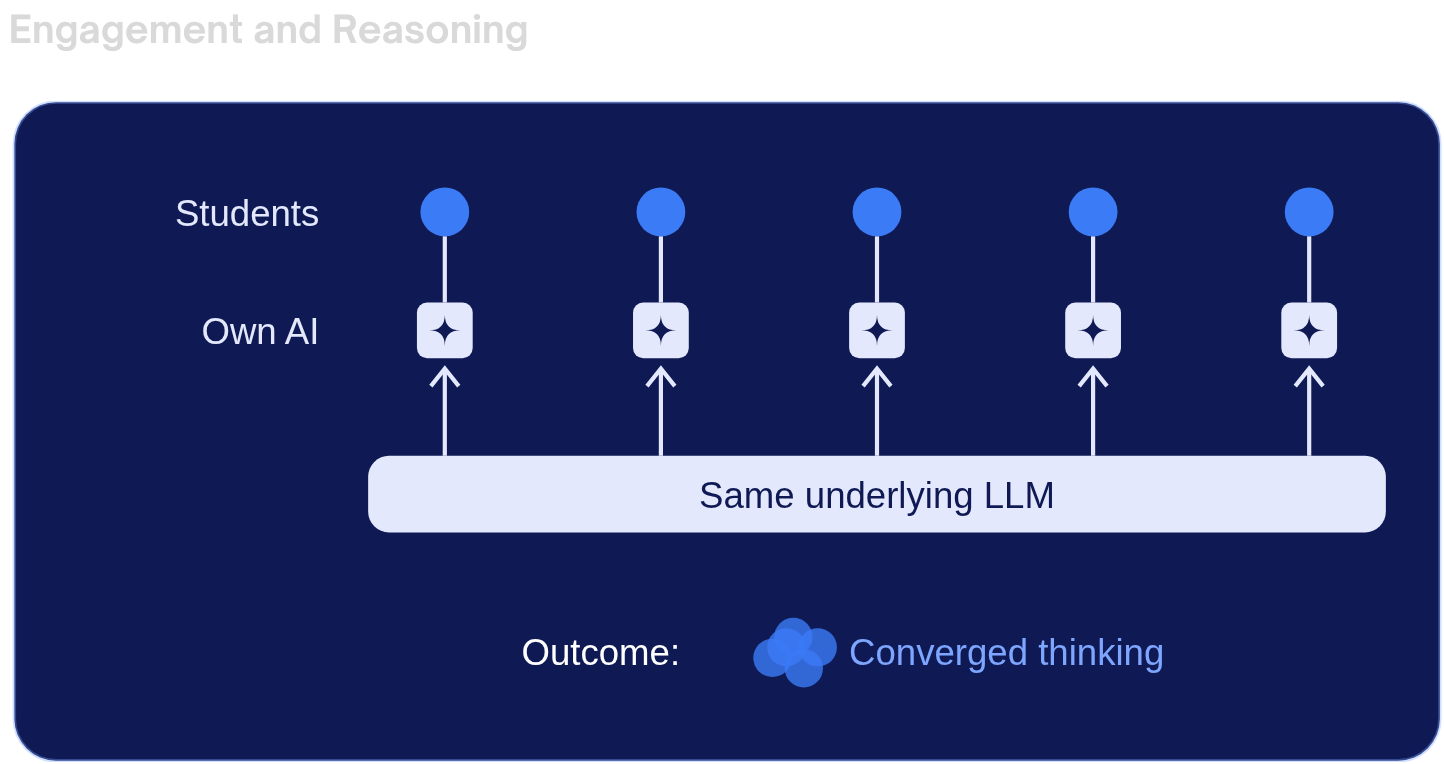
Reliance on AI leads to homogenised reasoning

AI systems draw responses from the same underlying model distribution. As students route their reasoning through the same small set of LLMs, thinking converges.

04/
07
·
Key Challenges

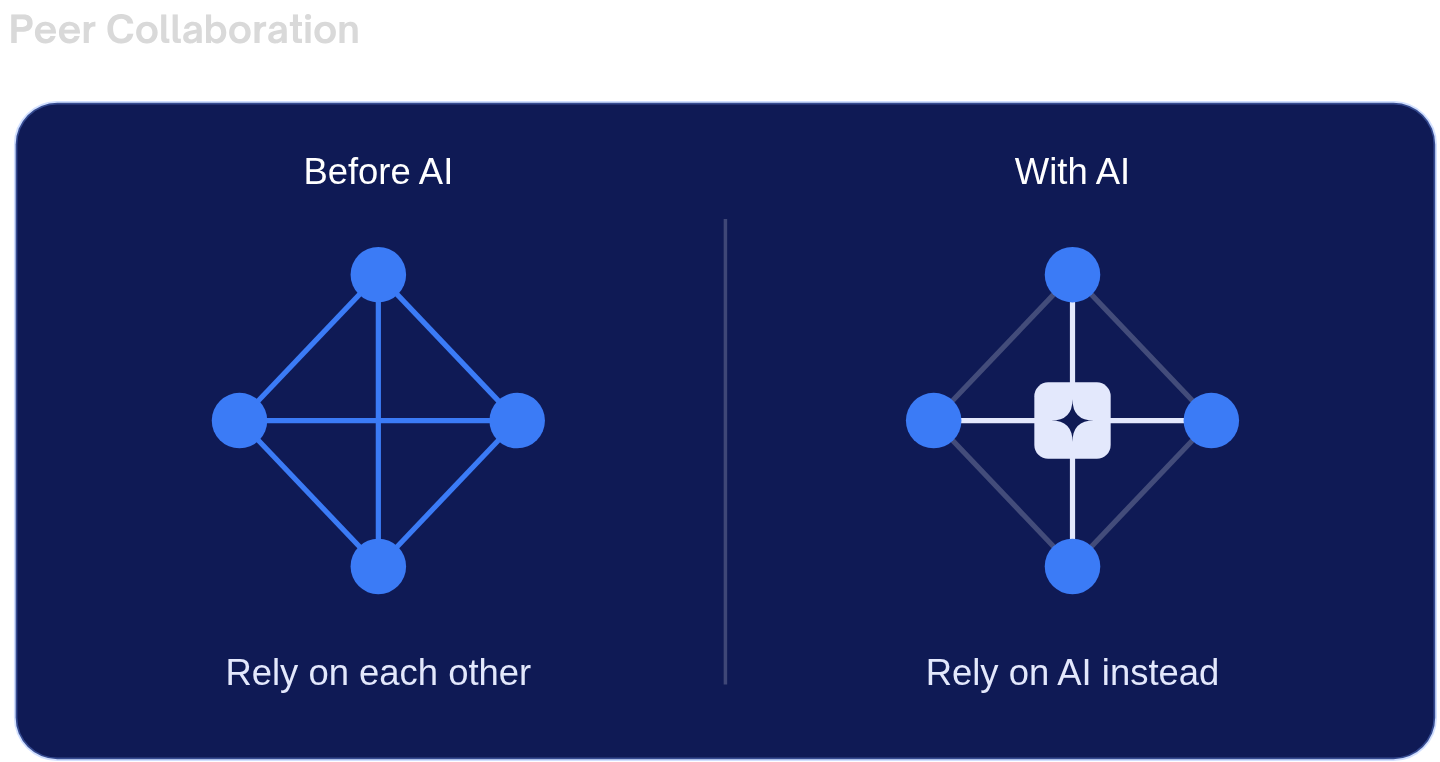
Reliance on AI leads to homogenised reasoning

AI offers students help and discussion support that can negate the need for a groupmate. This weakens overall collaboration by giving students a new avenue to rely on instead in and out of collaborative settings.

05/
07
·
Key Challenges

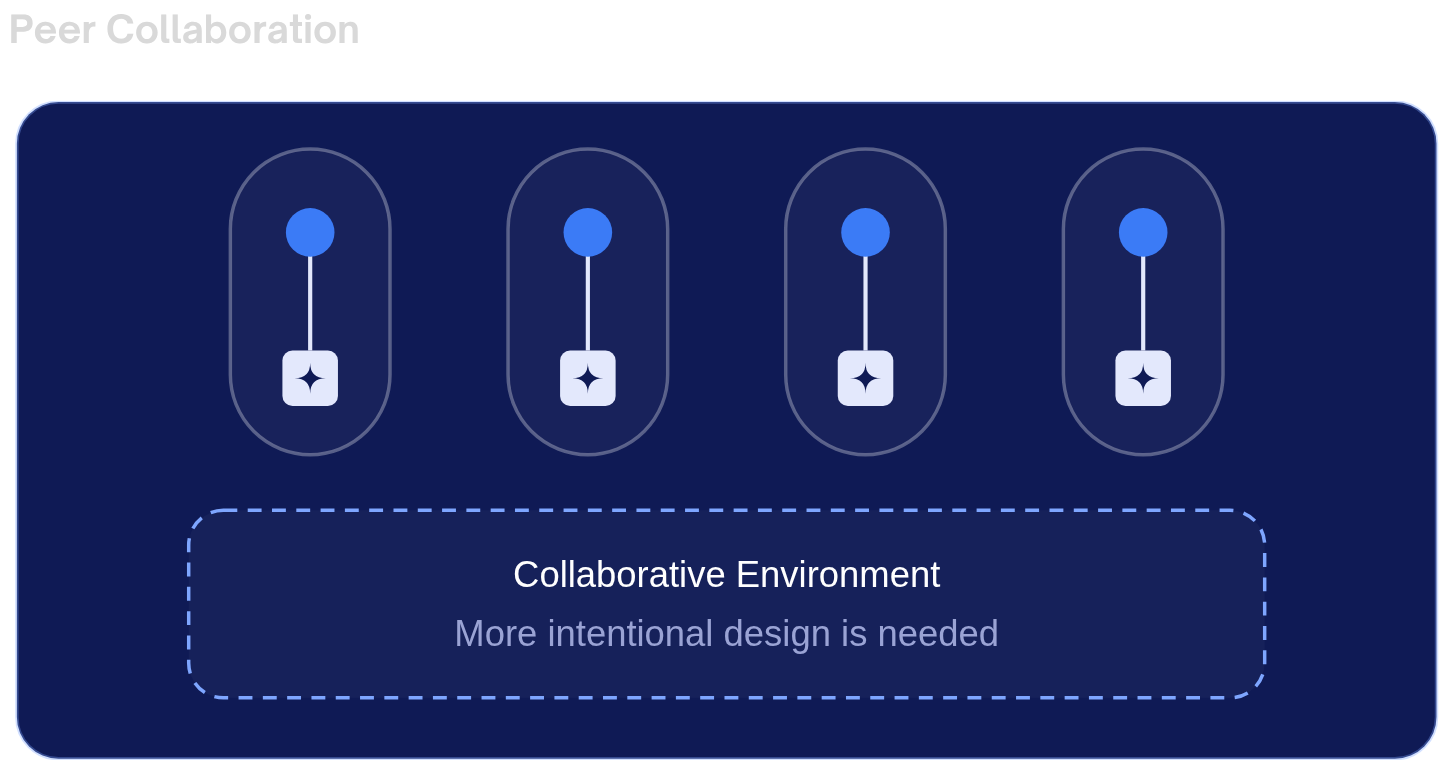
Increasingly siloed learning workflows

AI is increasingly used as an individual support tool, helping students work through tasks independently (Digital Education Council AI in Higher Education Global Survey 2026). This risks shifting learning into isolated workflows, reducing opportunities to develop the collaborative skills higher education is expected to cultivate.

06/
07
·
 Learning Mechanisms

Seven Mechanisms Drive Learning in Collaborative Groups

Collaboration produces learning through seven mechanisms, acting on the individual student, between students and across the group. None of them needs AI, but AI changes whether each one happens. It can magnify a mechanism, outsource it or bypass it.
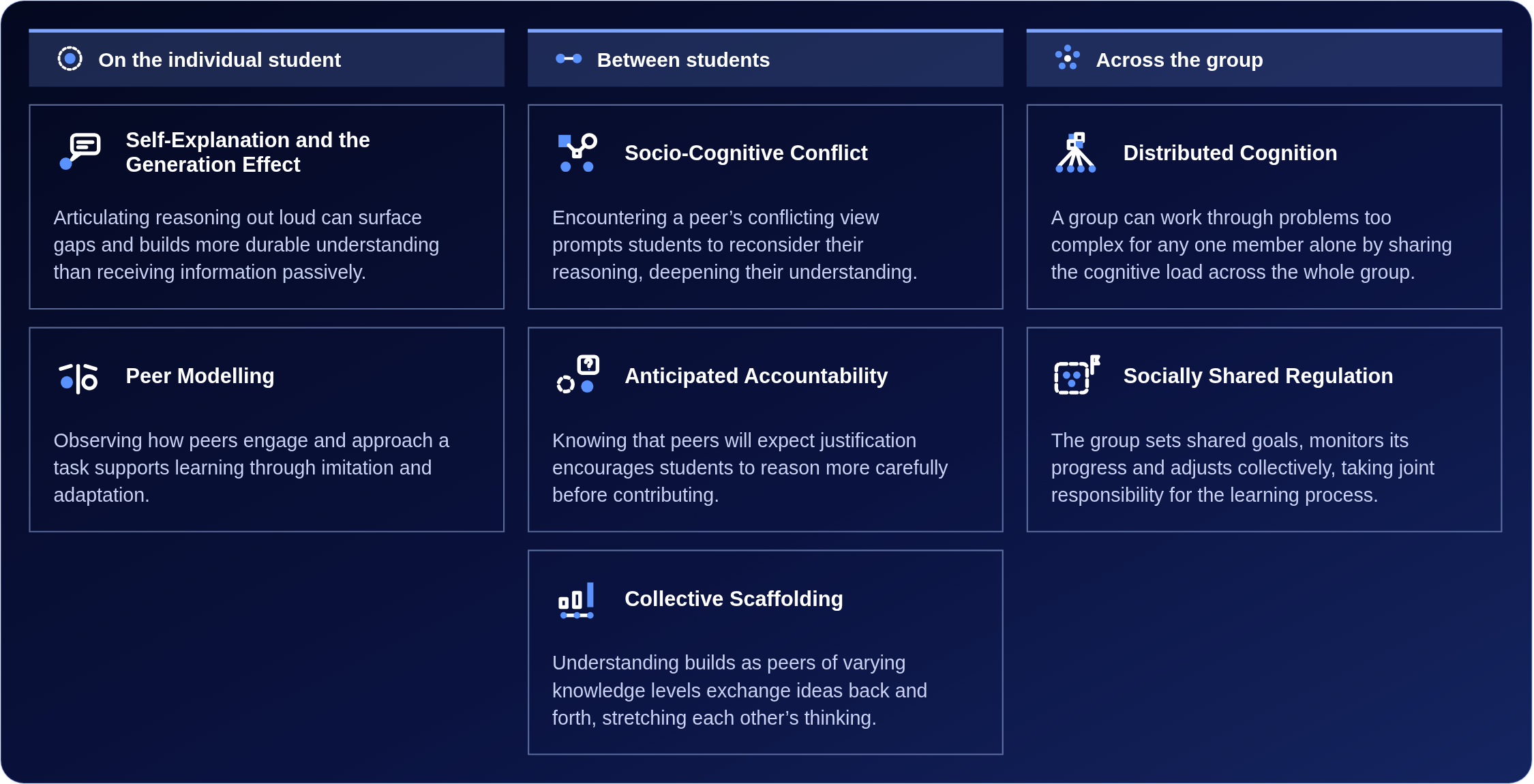
How AI Affects the Way Groups Learn

The seven learning mechanisms drive learning in groups are transformed in the age of AI. Click into each one to see how AI can magnify it, outsource it or bypass it.

On The Individual Student

Between Students

Across The Group


07/
07
·
Methodologies

Emerging Methodologies to Use AI for Collaborative Learning

Drawing on more than 80 global case studies, the report sets out 15 methodologies across the three stages of collaboration. Each shows how AI affects the seven learning mechanisms, how it works in practice and a notable case.
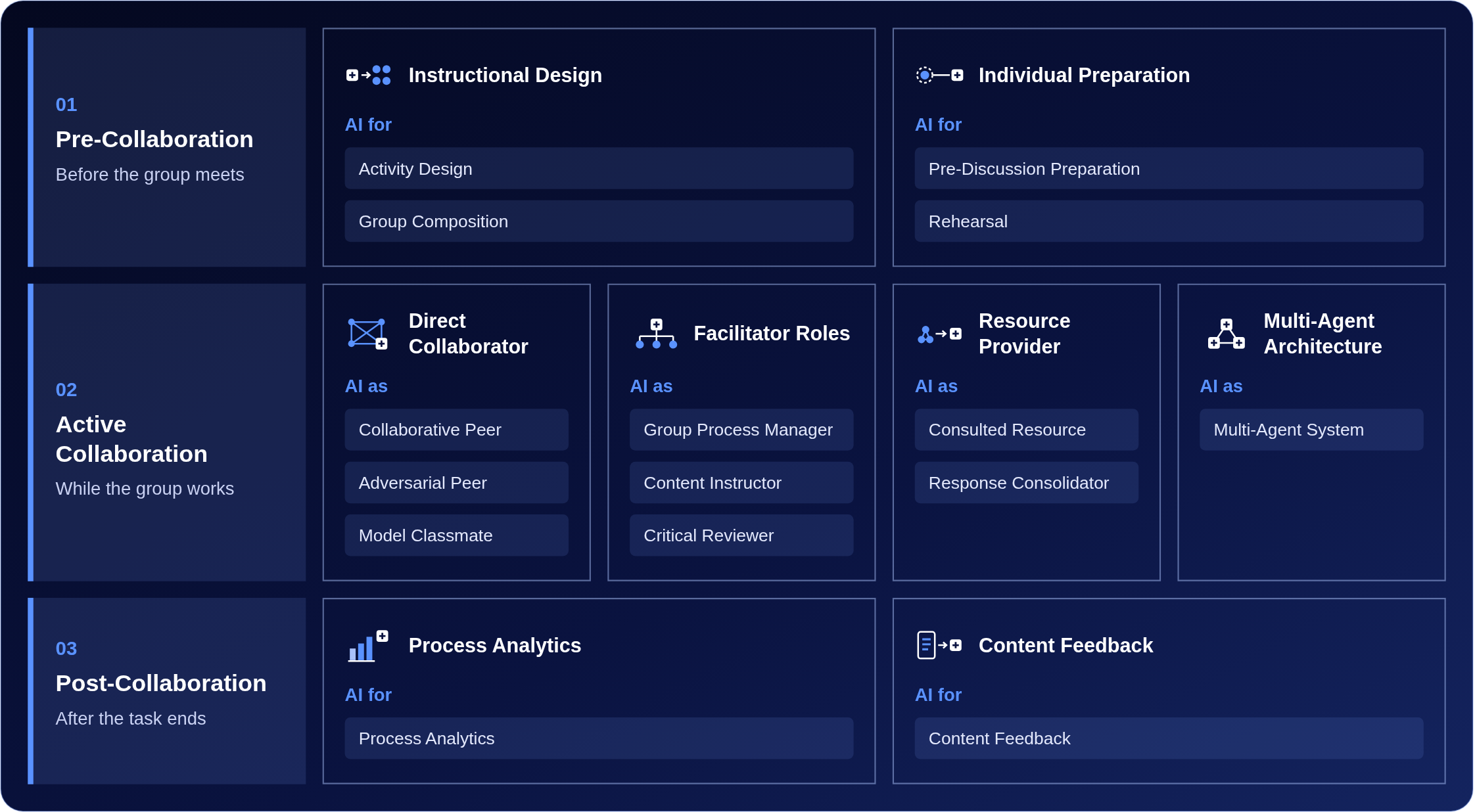
 15 Emerging Methodology Cards

Active collaboration · Direct collaborator

AI as Adversarial Peer

AI holds and defends a contrarian or minority position inside a group’s discussion, putting productive disagreement at the forefront as a design choice. It can operate as an embedded dissenter within the group or as an external party the whole team negotiates against.


Impact on learning and mechanisms

+ Socio-cognitive conflict:

Disagreement no longer depends on the group containing differing views. AI can hold the opposing view.

AI can dissent without fatigue, and students do not risk disapproval by voicing opposing views.

+ Anticipated accountability:

Knowing AI will challenge every argument pushes students to prepare their reasoning.

The group’s final position is built with weak points addressed in advance.

– Socio-cognitive conflict:

Where AI always supplies the opposing view, students may stop generating counter-arguments of their own.

Students learn to defend against dissent, but less often raise it themselves.

How it works

  1. Configure the position: The instructor sets AI up with a stance to hold, such as a minority view, a devil’s advocate role or an opposing negotiating party, and adjusts the difficulty to the group’s level.
  2. Hold the position: AI joins the discussion and defends its stance, raising objections one at a time, without agreeing too quickly.
  3. Engage directly: Students respond together, building counter-arguments or revising their reasoning, and weigh each other’s views as well as AI’s.
  4. Sustain and resolve: AI keeps challenging for as long as the activity requires, then prompts students to reach a decision and explain their reasoning.

Notable case

AI-supported negotiation simulation, University of Lincoln

  1. Postgraduate business students work in teams of four to six, each taking a business role such as CEO, CFO or Head of Supply Chain.
  2. A single Copilot prompt sets AI up as a coach first. It matches the team’s level, builds a negotiation scenario and runs a short planning check.
  3. As the counterpart, AI raises one realistic demand or objection at a time and is instructed not to make the negotiation too easy.
  4. Students reported greater readiness to negotiate. The biggest gain was in judging when to trust an AI suggestion and when to push back.

Discover the other methodologies

Authors
Vincent Liardi
Global Lead for Industry
Engagement & Advocacy
Pearson
Alessandro Di Lullo
CEO
Digital Education Council
Danny Bielik
President
Digital Education Council
Hui Rong
Research & Intelligence Lead
Digital Education Council
Charlene Chun
Research & Intelligence Associate
Digital Education Council
Maftuna Mavlonova
Research & Intelligence Associate
Digital Education Council
Fathinah Subhan
Research & Intelligence Associate
Digital Education Council

Download the Full Report

DEC Member?

Log in for instant access to this and all member resources.
Member Login
Not sure if your institution is a DEC Member? Find out here →

Access with Registration

Complete the form below to access this free resource.

Explore More Resources

🔒 Please log in to download this material