
By Digital Education Council
.
August 21, 2026
Executives are often assumed to be among the least automatable workers, as strategy and leadership still rely heavily on human judgement.
The Digital Education Council AI Skills Opportunity Map, a global AI readiness research initiative engaged by Google.org, broadly supports that view. But its profile of Chief Executives and General Managers suggests a more important change is already under way.
AI may not be replacing executive judgement, but it is increasingly producing the analysis on which that judgement rests. Forecasts and risk assessments that once passed through several layers of human analysis can increasingly be generated by machines. That changes where executive judgement begins.
The emerging skills gap may therefore lie less in using AI than in judging the work it produces.
Automation Absorbs the Structured Half of Executive Work
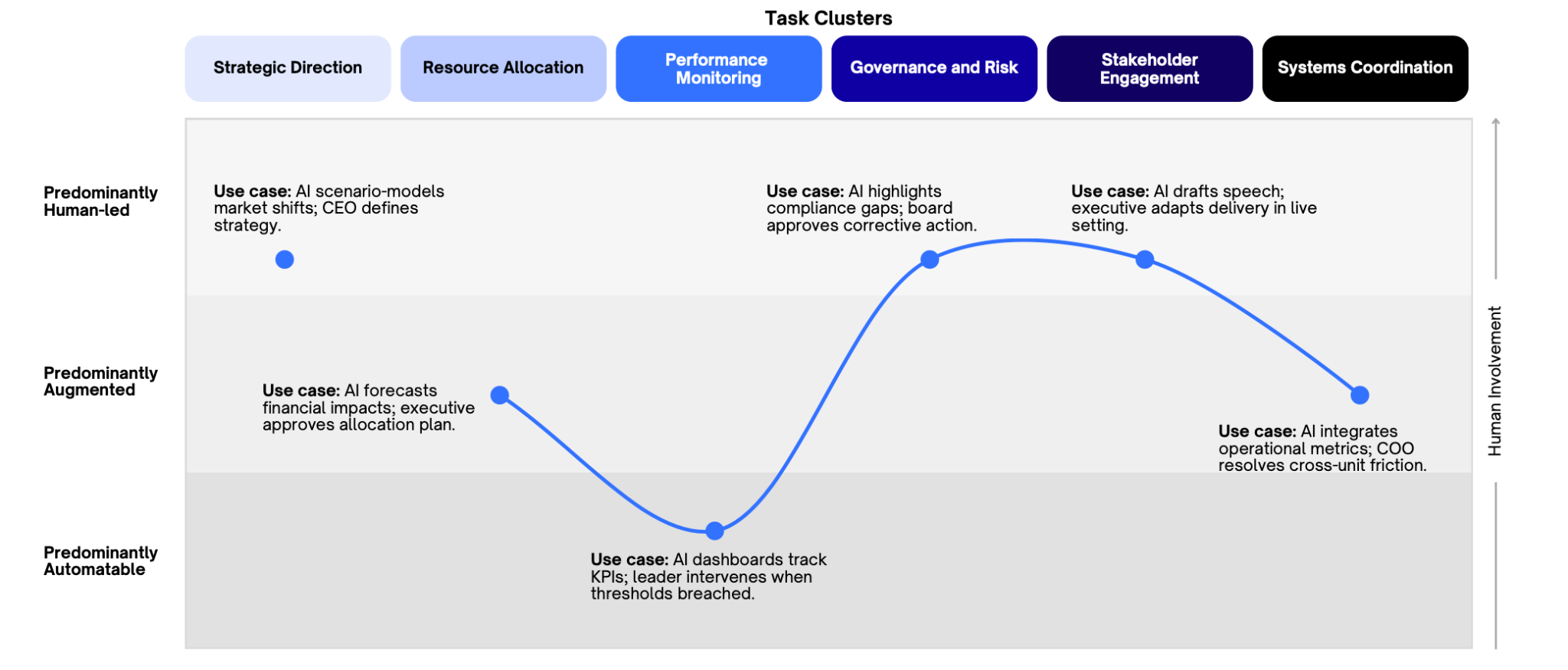
Executive work covers a wide range of activities, and AI will not affect them evenly. Structured tasks such as gathering information and monitoring performance are more open to automation than tasks that require executives to weigh competing interests or take responsibility for uncertain outcomes.
Performance monitoring illustrates this most clearly. AI can already track central metrics and identify variances with minimal oversight. That leaves executives to judge how significant a deviation is and what response follows.
AI can model the financial effects of resource allocation, but the final decision remains a human responsibility. Scenario planning makes the reason clear. Where a team of advisers once built out competing options by hand, AI now generates them directly from the data. Advisers no longer test each option's assumptions before it reaches the leader. What remains for the leader is the choice between them, and the trade-offs that choice carries.
Strategic direction and engagement with external groups such as boards and regulators sit further from automation's reach. These functions are qualitative, and their success cannot be measured against a predetermined algorithm. As machines take on more of the analytical work, executive value concentrates in interpreting it and acting on it.
Decision Governance Is Becoming a Top Executive Skill
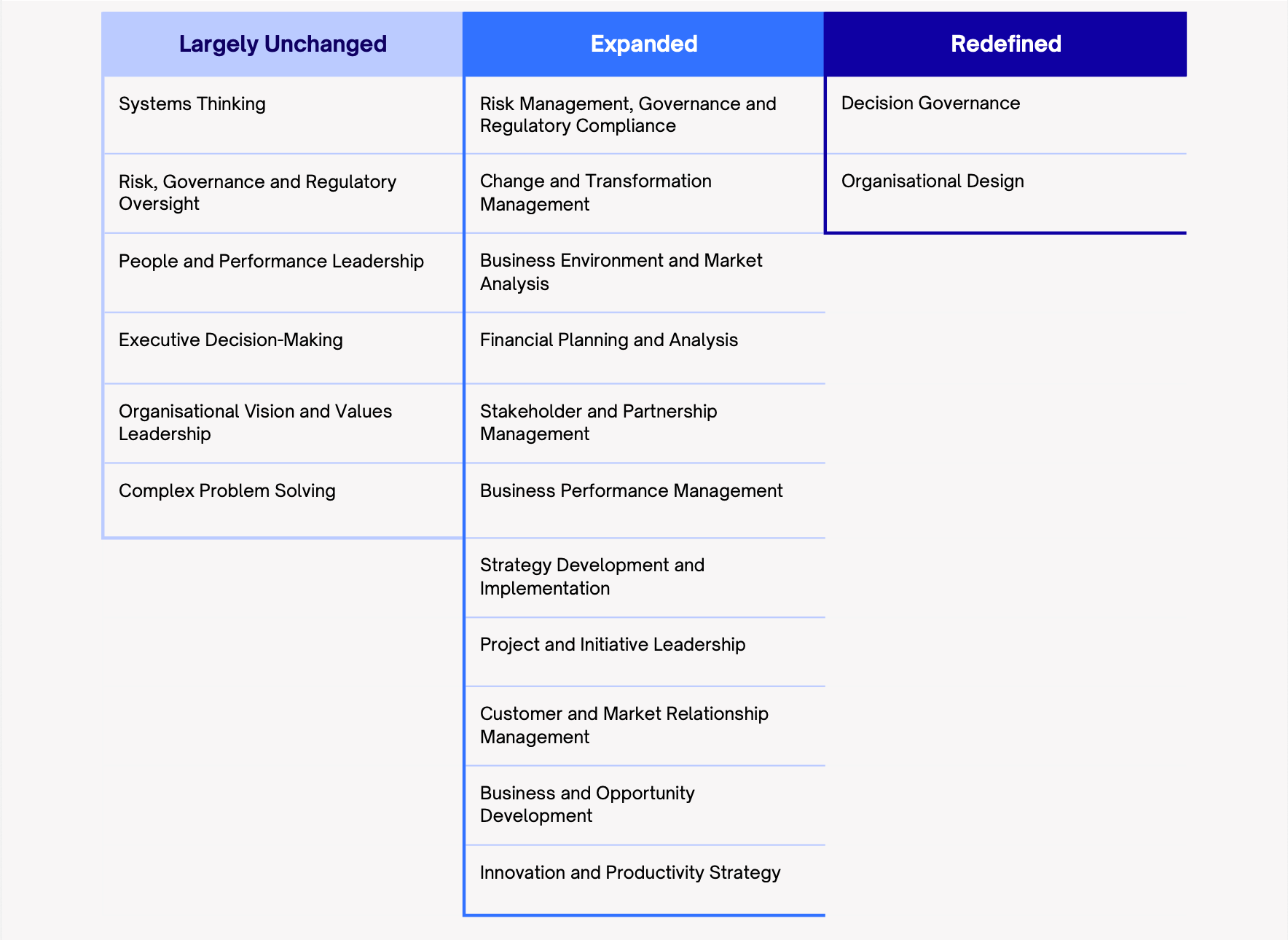
The AI Skills Opportunity Map identifies decision governance as a skill being redefined within this job family.
AI now produces the forecasts and risk assessments that analysts once built by working through each step by hand, and executives receive that output directly. A layer of work executives have relied on for decades disappears with it. What remains is judging the analysis, a shift few executives have been trained for.
Organisational design is not exempt from change.
Leaders have traditionally built structures around people and processes, not algorithms. Most current governance models were never designed to answer a simple question: who is accountable when a machine-generated forecast turns out to be wrong.
Substantial organisational transformation is likely to be needed before this question has a settled answer, as leaders decide how automated systems fit into their structures and where accountability sits when a machine-generated output drives a major decision.
Leadership Education May Be Testing the Wrong Part of the Decision
An understanding of this job profile points to a gap in how business schools and executive education teach and evaluate future leaders. The case method asks students to build the analysis themselves, then decide what to do with it. However, that sequence now tests a skill no longer done by humans alone.
The more useful test is whether a candidate can judge analysis rather than produce it: defending a decision once the evidence is already assembled, and recognising when that evidence should be questioned.
If machines keep taking over that analytical layer, the scarce skill will not be producing more analysis. It will be knowing when not to trust it.
The Digital Education Council AI Skills Opportunity Map is available for download here.